How to Match Pantone Colors on Custom Merch (2026)
Key takeaways
- Pantone gives every color a number, so your brand shade means the same thing to you and to the maker.
- The same Pantone code looks different on fabric, ink, and thread, because each surface takes light in its own way.
- Screen printing mixes to a color formula, DTG and DTF get close on most shades, and embroidery matches to the nearest stock thread.
- A cut-and-sew maker can dye the fabric itself to your Pantone target, so the whole garment matches, not just the logo.
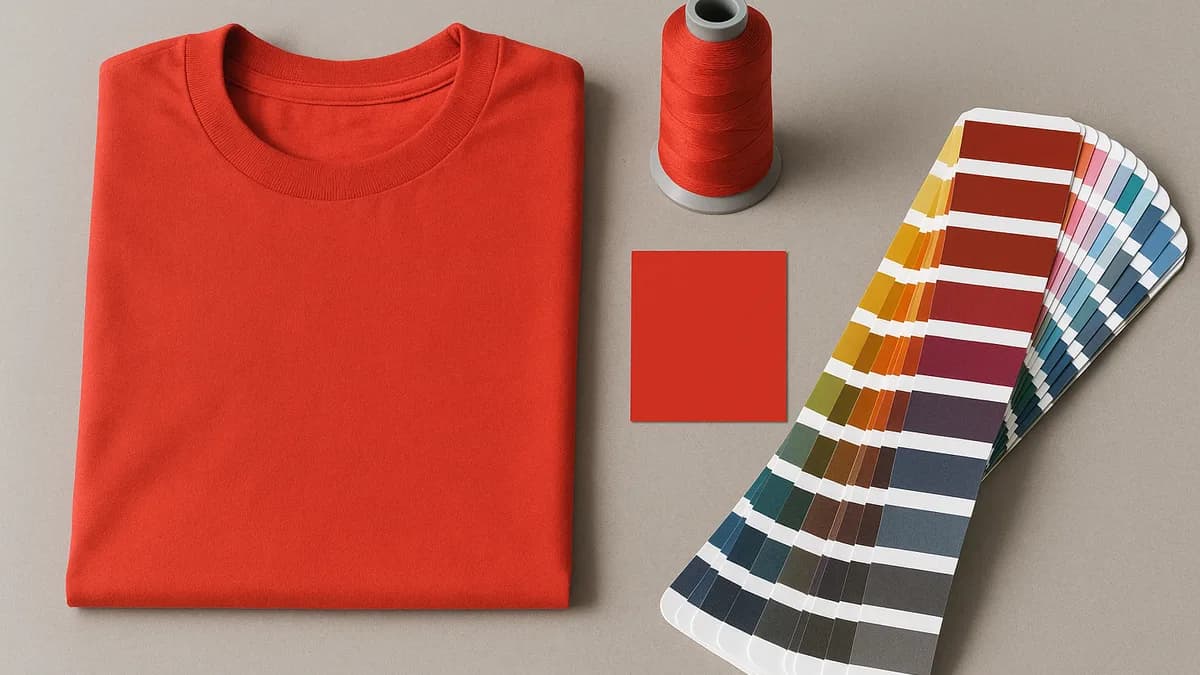
Pantone color matching is how your brand red stays your brand red, whether it lands on a woven tee, a stitched cap, or a printed hoodie. Get it wrong and the merch looks off-brand before anyone even reads the logo. This guide explains how color matching works on apparel, why exact color matters so much, and how a shade shifts as it moves across fabric, ink, and thread. It also shows how to brief a maker so the result matches the swatch you signed off on instead of drifting a shade away. Our corporate merch service handles that matching for you, from the dyed fabric all the way to the decoration.
What Pantone color matching means for custom merch
Pantone is a standardized color system. Think of it as a shared language for color. Every shade gets a number, so a designer in Los Angeles and a dye house across town can name the exact same color without either one guessing at what the other meant. When you hand a supplier a Pantone code like 186 C, you are pointing at one precise color in a global reference book rather than describing it with words that mean slightly different things to different people. On custom merch that precision is the whole game, because the word "red" covers thousands of reds and only one of them belongs to your brand.
Why exact brand colors matter on merch
Color is memory. People recognize a brand by its color before they ever process the wordmark, and research on brand recall keeps landing on the same conclusion, that consistent color lifts recognition by a meaningful margin over a look that wanders from one item to the next. Your merch is a walking billboard, so a jacket that runs slightly orange when the brand is a specific warm red quietly tells everyone the company cut a corner somewhere. That is the real risk. A near miss reads as a knockoff even when the logo itself is perfect, and it chips away at the exact impression the merch was built to create. The stakes climb with the size of the order, since a thousand pieces that all drift the same wrong direction turn one small slip into a thousand walking reminders of it. Matching to a defined code removes the guesswork so every piece carries the same color your website, packaging, and storefront already use.
How color behaves across fabric, ink, and thread
Here is the part most buyers miss. A Pantone chip is printed on coated paper, and fabric is nothing like paper. The same number will read differently on a matte cotton tee than it does on a glossy nylon shell, because each surface absorbs and bounces light in its own particular way, which means the color your eye registers changes with the material even when the target code on paper has not moved at all. Ink soaking into a knit lands a touch darker and softer than that same ink sitting on a smooth card, thread catches light along the twist of its fiber, and dyed cloth carries color all the way through the yarn instead of resting on top of it. That is why the system publishes separate libraries for coated stock, uncoated stock, and textiles, and why a careful decorator asks which surface your color is landing on before promising anything.
Pantone references and the systems that matter
Pantone is not one single list. The one most people know is the PMS, the Pantone Matching System, built for ink and printing and written with a C for coated stock or a U for uncoated. For fabric there is a second world entirely. The Pantone textile libraries use codes like 19-4052 TCX, and a TCX chip is a swatch of dyed cotton made specifically so a dye house can match cloth rather than paper. Brief apparel with a PMS number and you get close, brief it with a TCX number and you get closer, and hand over a physical swatch and you beat both of those on the first try. The table below lines up which reference does what job.
Keep both a paper reference and, when the color is critical, a textile one. The paper code tells the printer where to aim, and the textile code tells the dye house.
Pantone matching by decoration method
Every decoration method reaches color differently, and knowing that upfront saves you a reorder. Screen printing mixes ink to a Pantone formula, so it is the most reliable path to a dead-on match on a printed graphic. DTG and DTF build their color from process inks, which get very close on most shades but can wrestle with the brightest oranges, the deepest navies, and anything neon. Embroidery does not mix color at all. Thread arrives in fixed stock colors, so matching there means choosing the closest thread to your Pantone number off a physical thread card, which is why a stitched logo is a near match by its very nature rather than a mixed-to-formula one. We compare all four methods in depth in our guide to screen printing vs embroidery vs DTG and DTF, and the color behavior is a big reason the right method depends on the piece.
Need your exact Pantone colors on every piece? Send us your color codes or contact our LA team and we will match the fabric and the decoration to your brand.
Where color matching hits its limits
Planning a merch run? Get a free quote from our LA team.
Tell us your pieces and quantities. We make retail-quality corporate merch in Los Angeles and will follow up with pricing and lead times, usually within 24 hours.
No process reaches every color perfectly, and honest suppliers tell you so upfront. Neons and metallics sit outside what standard process inks and stock threads can reach, so a fluorescent shade usually needs a specialty ink or a knowing compromise on the closest available option. Very dark and very saturated colors can shift as fabric dye lots vary from batch to batch, and even a first-rate dye house works to a tolerance rather than a flawless photocopy of the chip. Light changes everything your eye sees, so a color approved under warm shop lighting can read noticeably cooler out in daylight, a trap the industry calls metamerism. None of this is mystery. Approve color on the real material, under neutral light, against a physical Pantone chip, and agree on a tolerance you can live with well before production starts.
How to brief your supplier for accurate brand colors
A clean brief is the difference between one proof and three. Give your maker the exact codes and the context around them, and the match tightens fast.
- Send the Pantone code and the library. "186 C" plus "19-1664 TCX" tells a supplier far more than "our brand red" ever could.
- Say where each color lands. Note fabric versus print versus thread for every color, since the same shade behaves differently on each one.
- Provide a physical reference. A swatch, a previous garment, or a printed chip removes the last of the guesswork about what you actually mean.
- Ask for a strike-off or proof. Approve real material before the full run rather than signing off on a screen mockup.
- Set your tolerance. Tell them how close is close enough, so nobody over-engineers a shade nobody in the room would ever notice.
Do that and the back-and-forth collapses into a single round. See how color prep folds into the wider quote in our breakdown of custom company apparel cost, where getting files and codes right early keeps revisions from creeping the price upward.
Why made-in-LA cut-and-sew nails color matching
This is where a real manufacturer pulls ahead of a blank-and-print shop. When we build garments from scratch in Los Angeles, we can dye the fabric itself to your Pantone number instead of hunting for a pre-made blank that happens to sit somewhere near it. That means the body of the shirt matches your brand, not only the logo pressed onto it. A print shop working from stock blanks is boxed in by whatever colors the blank maker chose to offer, so the closest it can manage is a decoration match sitting on top of an approximate garment. Cut-and-sew flips that whole equation. Fabric, thread, and print all get matched to one shared target under a single roof, and the finished pieces arrive reading as one coherent brand rather than a set of near-misses. That coordination is the quiet advantage of building instead of buying, because a color decided once at the fabric stage carries through every later step instead of getting re-approximated at each one. Our corporate merch team runs that process end to end, and we lay out the tradeoff plainly in cut-and-sew vs blank decoration.
Frequently asked questions
What is Pantone color matching on merch?
It is the practice of specifying your brand colors by their Pantone number so a maker can reproduce them precisely. Instead of describing a color in words, you name an exact code, and the ink, dye, or thread is matched to it across every piece.
Will my Pantone color look exactly the same on fabric and print?
Not perfectly, because fabric and paper take light differently and each material shifts the color a little. The code gets you very close, and approving a physical proof on the real material is how you confirm the final result before production.
What is the difference between PMS and TCX Pantone codes?
PMS codes describe ink on paper and are used for printing and decoration. TCX codes describe color on dyed cotton and are used for fabric. Give a supplier both when the garment body and the print both need to match your brand.
Can embroidery match a Pantone color?
Embroidery matches to the closest available thread rather than mixing to a formula, so it is a near match by nature. A good decorator picks the nearest stock thread to your Pantone number off a physical thread card and confirms it with you first.
How do I make sure my supplier matches my brand color?
Send the exact color codes with the right library, say where each color lands, provide a physical swatch, and ask for a proof on real material. Agree on a color tolerance upfront so everyone knows how close counts as approved.
Get a Corporate Merch Quote | Use Our Cost Calculator | Contact Us
Related reading: Screen printing vs embroidery vs DTG vs DTF · How much custom company apparel costs · Cut-and-sew vs blank decoration · Cut-and-sew manufacturing
Planning a merch run? Get a free quote from our LA team.
Tell us your pieces and quantities. We make retail-quality corporate merch in Los Angeles and will follow up with pricing and lead times, usually within 24 hours.
Plucky Reach
Fashion Business Consulting • Los Angeles Fashion District
Plucky Reach is a fashion business consulting firm based in the Los Angeles Fashion District. We have helped 1,000+ clothing brand founders go from idea to production, from first sketch to retail shelf. Our team has 20+ years of direct relationships with LA garment manufacturers, and we specialize in connecting emerging brands with the right production partners.